




Vibration is a real, measurable intervention. The tools that deliver it range from serious medical devices to branded lifestyle toys. The research supports some uses fairly well and others not at all.
- Post-workout DOMS
- Pre-activity warm-up
- Acute pain modulation
- Peripheral circulation
This piece treats vibration therapy as it should be treated — a specific modality with specific effects, useful in specific situations, and much less magical than the marketing suggests. Particularly relevant if you're considering a massage gun or a whole-body vibration plate to help with foot, leg, or generalised recovery.
The three modalities you'll actually encounter
Whole-body vibration (WBV)
A platform that vibrates, usually at 20–50 Hz with amplitudes of a few millimetres. You stand on it, sometimes holding poses. Originally developed for astronauts (to offset muscle atrophy in microgravity), now marketed for everything from weight loss to osteoporosis.
Local vibration — massage guns / percussion devices
Handheld devices delivering rapid percussive impacts, usually 20–50 Hz at the target tissue. Applied directly to muscle groups for 30 seconds to a few minutes.
Vibrating foam rollers and small devices
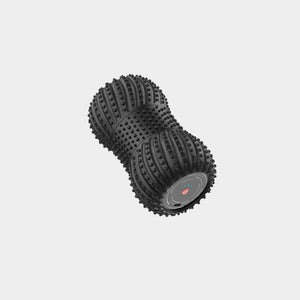
Foam rollers with internal motors; vibrating balls for plantar fascia and trigger-point work. Lower intensity than massage guns, used for self-myofascial release.
What the evidence actually shows
Reading across the research, vibration has reasonable evidence for a handful of specific outcomes and weak or non-existent evidence for most of the others.
Reasonably supported
- Delayed onset muscle soreness (DOMS) reduction. Meta-analyses show a modest but real reduction in post-exercise soreness when vibration is applied shortly after training [1]. Useful but not dramatic.
- Short-term range of motion improvement. Vibration before stretching or activity produces measurable (if brief) increases in joint ROM. Can be useful as a pre-workout tool.
- Acute pain modulation. Vibration activates large-diameter nerve fibres, which can inhibit pain signals at the spinal cord (gate control theory). You feel less pain while the device is on — a small benefit for musculoskeletal pain but not a cure.
- Peripheral circulation. Local vibration increases blood flow measurably in the target area. Useful in cold-feet or poor-circulation contexts.
Weakly supported or mixed
- Bone density in older adults from whole-body vibration. Some positive studies in postmenopausal women; many negative. Not strong enough to recommend as standalone osteoporosis therapy.
- Balance and proprioception improvement. Some evidence in older adults; unclear whether the effect is from the vibration itself or from standing on an unstable platform.
- Muscle strength and power. Small effects in some studies; disappear in others.
Not supported
- Fat loss. Despite marketing claims.
- Cellulite reduction. Despite marketing claims.
- "Detoxification." A meaningless term in this context.
- Healing chronic tendon problems faster than loading exercise. Loading does the repair; vibration is a bystander for tendinopathy.
What vibration doesn't do
A brief honest list of common misconceptions:
- Vibration doesn't replace stretching. The range-of-motion effect is short-lived. For lasting flexibility, you still need time-under-tension stretching.
- Vibration doesn't replace massage. The pressure and targeting of manual therapy are different. Massage guns approximate some effects of massage, but skilled hands do things devices don't.
- Vibration doesn't heal plantar fasciitis. It can reduce acute pain and aid short-term mobility, but the tissue remodelling requires load management and the Rathleff-style protocols.
- Vibration isn't risk-free. Over-aggressive massage-gun use can cause bruising, nerve irritation, and in rare cases rhabdomyolysis. Don't use near the throat, spine, or major nerves.
How to actually use it
If you own or are thinking of buying a vibration device, a reasonable usage pattern:
- Before activity: 30–60 seconds per muscle group on your target areas. Useful for warming up tight calves before a run or stretching session.
- After activity (for DOMS): 60–120 seconds per muscle group, within 1–2 hours of training. Most useful after hard sessions.
- For plantar fascia specifically: A vibrating ball or small device rolled slowly under the arch, 2–3 minutes per foot, twice a day. Modest effect; fine as one part of a larger routine.
- For general relaxation: Lower-intensity devices (vibrating roller, foot massager) in the evening, 5–10 minutes. Nice-to-have, not a clinical intervention.
- Avoid: Prolonged use on the same spot (>2 min), use over bone, use on acute injuries (<48 hours), use over bruises or broken skin.
“A massage gun is a useful tool. It is not a treatment plan. Own one, use it sensibly, don't expect it to do the work your exercises are supposed to do.”
For the broader picture of what recovery looks like after high-load days, see our sleep, recovery, and pain piece and our home exercise programme, both of which do more than any vibration device.
References
- Veqar Z, Imtiyaz S. Vibration therapy in management of delayed onset muscle soreness (DOMS). Journal of Clinical and Diagnostic Research, 2014.
- Rittweger J. Vibration as an exercise modality: how it may work, and what its potential might be. European Journal of Applied Physiology, 2010.
- Imtiyaz S, Veqar Z, Shareef MY. To compare the effect of vibration therapy and massage in prevention of DOMS. Journal of Clinical and Diagnostic Research, 2014.


